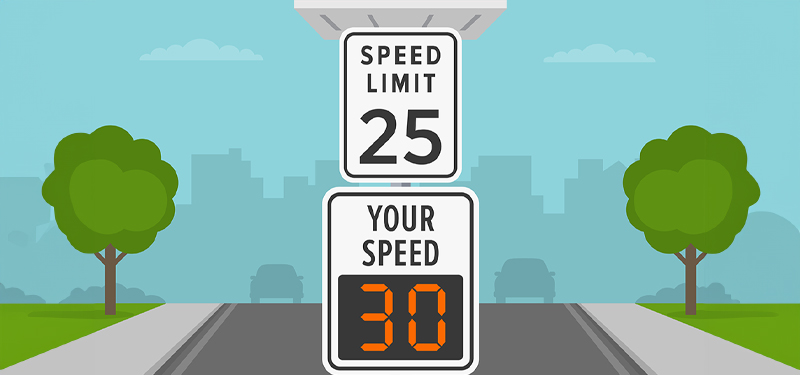
Traffic signals are an important part of the transportation network. They control the flow of all modes of traffic at our busiest intersections. With our partners in DPW, DTM engineers design, purchase, regularly inspect, and optimize all traffic signal equipment on Worcester-owned roadways. We also maintain and upgrade technology at intersections and mid-block crossings as needed.
When carefully and thoughtfully designed, traffic signals can provide a safe and efficient route through intersections for pedestrians, cyclists, micro-mobility users, public buses, and motor vehicles. On this page we will discuss the features of Worcester traffic signals.
Worcester owns and operates 175 stop-and-go traffic signals. Additionally, there are 34 signals that are within the City border that are owned and operated by MassDOT. Aside from the traditional signals, we also own and operate 110 rectangular rapid flashing beacons (RRFB), school zone beacons with radar speed feedback signs, and warning beacons.
When DTM was created in August 2022 and took over control of the traffic signal system, the inventory was largely paper based and lacked basic information on equipment, programming, and maintenance. In 2023, DTM worked with our consultant to develop a state of the art, GIS based, custom-built system that is now used to efficiently manage our inventory of traffic signals.
Vulnerable Roadway User Safety
Our traffic signals have many features that help protect the safety of pedestrians, cyclists, and micro-mobility users who are considered vulnerable road users. These include Exclusive Pedestrian Phases, Countdown Pedestrian Signals, Audible Pedestrian Signals, Bike Boxes, Left Turn Queue Boxes, and Protected Turns.
Exclusive Pedestrian Phasing
Most traffic signal systems in Worcester have Exclusive Pedestrian phasing which stops all motor vehicle movements when pedestrians have the walk sign. This allows pedestrians to safely cross a signalized intersection in all directions, including diagonally, while all vehicle traffic is stopped.
Countdown Pedestrian Signals
At most Worcester intersections with traffic signals, we have upgraded the pedestrian signals to include a countdown legend. The legend indicates how much time, in seconds, pedestrians have remaining to cross the street.
Countdown signals provide pedestrians with more information than the traditional WALK and DON’T WALK indications. In Worcester, flashing DON’T WALK intervals are based on the federal standard walking speed of 3½ feet per second, but many people walk faster than that pace and some slower. With the countdown signal, there is no mystery to how much time is remaining, and each person can decide if there is enough time to cross based on their ability.
Audible Pedestrian Signals
DTM is in the process of installing modern, pole-mounted audible pedestrian signals (APS). The new units will replace older units that are mounted to the pedestrian signals that make tapping, drumming, or chirping tones. APS push buttons are intended to aid the visually impaired pedestrians navigate the intersection. Any of several dozen settings can be adjusted, including volume levels and the nature of the audible tones. The units are programmed so that the WALK sign audible message will activate only when the button is pressed. Only the locator tone, which is designed to be heard within 10 feet of the pole, will be active at all hours. Learn More About Aspects and Safety Benefits of APS Signals
Protected Turns
Turns at traffic signals fall into one of three categories: Permitted, Protected, and Permitted-Protected. At smaller intersections, turns are usually permitted, meaning the motorists may turn left or right after yielding to other vehicles and all pedestrians and cyclists. With a protected turn, the motorist is shown a green arrow and may turn only when the arrow is shown. Permitted-Protected is when a combination of the above is used. At our larger intersections, we have been converting permitted turns - especially left turns - to Protected only to protect the turning driver from potential collisions. When a turn is protected, pedestrians, cyclists, and other vehicles are protected as well because they are programmed to use the intersection during a different time in the signal cycle.
Rectangular Rapid Flashing Beacons
To improve pedestrian visibility and increase driver awareness at uncontrolled, marked crosswalks, Worcester installs pedestrian actuated Rectangular Rapid Flashing Beacons (RRFB). RRFBs consist of two rectangular-shaped yellow indications, each with a light-emitting diode (LED)-array-based light source. RRFBs flash with an alternating high frequency when activated to enhance pedestrians’ visibility at the crossing to drivers. To further improve pedestrian safety at these crosswalks, DTM has standardized use of a spotlight that illuminates the crosswalk for the pedestrian and the pedestrian for the driver. Learn More About Rectangular Rapid Flashing Beacons
Pedestrian Hybrid Beacon (Formerly Known as HAWK Signals)
DTM is exploring the use of Pedestrian Hybrid Beacons (PHB), a new type of traffic signal to further improve pedestrian safety. PHBs contain two adjacent red lights and one yellow light. Pedestrians activate it upon arrival. The new light protects pedestrians like a regular traffic signal, yet allows vehicles to proceed through the intersection when the crosswalk is empty. Learn More About How Pedestrian Hybrid Beacons Operate
School Zone Flashers
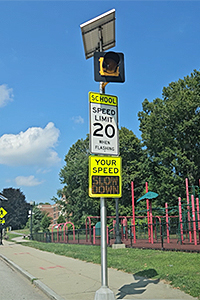
The beacons on School Zone Flashers are programmed to activate before school starts and deactivate after the school day ends. When activated, the speed limit on the street is 20 MPH. To improve safety around schools, DTM is installing school zone flashers with radar feedback display boards to encourage drivers to slow down through real time information about their operating speed. DTM engineers program these signs to schedule when the beacon flashes, and when the speed limit changes for school zones. They also put exceptions in the schedule for holidays and other times when school is not in session.
Traffic Signal Projects
While DTM is regularly making smaller-level improvements to our traffic signal system, below are larger-scale projects being undertaken to improve the efficiency, safety, and accessibility at specific signalized intersections.
Lincoln Square Traffic Signal Improvements
Traffic control at Lincoln Square has evolved dramatically to meet the needs of roadway users in Worcester over the years. While the intersection's control technology is among the newest in the City, the complexity of the controller's configuration has frequently caused the traffic signal to malfunction. Currently the signal is set to pre-time because neither the emergency vehicle preemption nor vehicle detection is working properly. To view our consultant's assessment of the intersection, view the T&B Lincoln Square Traffic Signal Improvement Memo.
During the summer of 2025, DTM began working with its contractors to update and simplify the configuration to ensure the reliability of detection technology at this intersection based on the recommendations in the memo. This technology ensures not only that passenger vehicles approaching the intersection are detected to request green time but also that emergency vehicles have priority access through the corridor. Additionally, recommendations 2 & 3 from the memo to restore the signal to full operations including video detection of vehicles, phasing improvements, and timing optimization were implemented. This is the first time since the signal was upgraded in early 2020s that the signal is fully functioning as designed.
Next steps will include a comprehensive study, plan development, and implementation to make the signal more responsive to today's traffic and pedestrian volumes. We will also integrate this critical signal to the management platform we use to monitor the operation of other intersections across the City.
Lincoln Street Corridor Traffic Signal Improvements
The current DTM project for this corridor will change all signals in the Upper Lincoln Street segment to use exclusive pedestrian phasing and optimize the timing of each traffic signal. Part of the optimization will restore coordination to the corridor so platoons of vehicles traveling the speed limit are able to progress efficiently along Lincoln Street, encountering fewer red lights. The intersections included in this project are:
- Lincoln Street at Beverly Road
- Lincoln Street at Goldthwaite Road/Trinity Avenue
- Lincoln Street at Lincoln Plaza Drive (West)
- Lincoln Street at Country Club Boulevard
- Lincoln Street at Lincoln Plaza Drive (East)
This project is expected to be completed in the fall. To view our consultant's assessment of the intersection and learn more about the plan, view the T&B Lincoln St. Signal Retiming Memo.
Round One MassDOT Bottleneck Grant Improvements (Main Street at Hammond/May, Main Street at King, Park Street at Salisbury)
MassDOT has a competitive grant program, the Local Bottleneck Reduction Program, that helps municipalities address congestion related to bottleneck conditions on local roadways. The grant covers 100% of the consultant costs to design the improvements and up to $500,000 toward construction. This year, DTM successfully applied for and was awarded a $500,000 Bottleneck grant to upgrade three intersections:
- Park Avenue at Salisbury Street
- Main Street at Hammond Street/May Street, and
- Main Street at King Street
These intersections experience significant amounts of congestion daily. Main Street is a major corridor that supports cross-City movement, while the Park Avenue intersection serves as a connector for two major collector corridors in the City. To reduce congestion and improve traffic operations at these intersections, the City will be upgrading the existing traffic signal equipment and related infrastructure. This work is expected to take place in 2026.
Main Street at May Street/Hammond Street
The Main Street at Hammond Street/May Street intersection facilitates traffic movement between the southern and central parts of Worcester to northern parts of Worcester through May Street. This intersection experiences high amounts of pedestrian traffic, as well, with a bus stop located in the middle of the off-set intersection. Due to the geometrical design of this intersection, implementing additional clearance phases and signal heads will significantly improve the safety benefit for vehicular traffic and pedestrians.
Main Street at King Street
The Main Street at King Street intersection is close to the Main/Hammond/May Street intersection. This creates an opportunity to improve the coordination between the traffic signals. As this project progresses, DTM and our partners will implement changes here that provide better safety and efficiency of movement for all travel modes.
Park Ave at Salisbury Street
The Park Avenue at Salisbury Street intersection connects two key corridors in the City, while also serving pedestrian traffic due to the proximity to the Worcester Polytechnical Institute campus. This portion of the Bottleneck Program project will consider better locations for the traffic signal components, evaluate lane configuration options, optimize vehicle and pedestrian phasing, and modernize the intersection.
Round Two MassDOT Bottleneck Grant Improvements (Park Avenue at Institute Road, Highland Street, Elm Street, and Pleasant Street)
The intersections of Park Avenue with Institute Road, Highland Street, Elm Street, and Pleasant Street experience significant concerns for the City of Worcester related to congestion and traffic operations. The Park Avenue corridor serves as a significant north-south commuter corridor just west of Worcester's Downtown.
The aging signal equipment and infrastructure, absence of emergency pre-emption, and lack of working detection (Institute Road) limits the ability of the intersections to adapt to the needs of the current traffic demand. These deficiencies were documented in the recently completed city-wide traffic signal inventory where these and other traffic operational bottlenecks were identified. In addition, the existing non-compliant pedestrian and bicycle accommodations all contribute to the existing congestion observed at these locations.
The project's goals aim to reduce congestion and improve traffic operations by upgrading existing traffic signal equipment and infrastructure at the intersections of Park Avenue with Institute Road, Highland Street, Elm Street, and Pleasant Street. A by-product of these improvements will be improvements to vulnerable roadway users including pedestrian and bicycle accommodation.
With the various hospitals located within the City, the installation of emergency pre-emption will support improved response times and better prioritize emergency vehicles at the intersections. Given the proximity of the intersections, coordination and communication between all four locations is needed to provide improved progression along Park Avenue and help alleviate existing queuing. Upgrades to more current vehicle detection equipment will allow System Performance Functions that will provide monitoring and periodic adjustments of these intersections to improve overall operation for all users.
These four locations will also build upon the current Bottleneck Reduction Project in design at the intersection of Park Avenue and Salisbury Street to help reduce congestion and improve operations along the Park Avenue corridor.
Granite Street at Heywood Street and Winthrop Street
This signal project will improve safety by adding a dedicated left turn signal onto Granite Street.
Southbridge Street at Cambridge Street
This signal project will improve safety by adding dedicated left turn signals onto Southbridge Street.
Elm Street at Chestnut Street and at Linden Street
This signal project will improve connectivity and traffic operations by converting Elm St to two-way operation from Main Street to Linden Street.
Webster Square
This signal project will improve traffic operations and safety by coordinating the traffic signals and adding dedicated left turn signal onto Main St from Mill Street.
Contact Information
Address
Transportation and Mobility
76 East Worcester Street
Worcester, MA 01604
Contact
Phone: 508-929-1300 ext. 49500
Fax: 508-453-2888
mobility@worcesterma.gov
Hours
Monday - Friday
8:30 a.m. - 5 p.m.