Trees enhance the beauty and value of homes, streets and communities. However, trees planted in the wrong place can cause property damage and become a detriment rather than an asset. Planning the location and species of a tree will ensure that the tree will be an asset and not grow into a hazard or a nuisance.
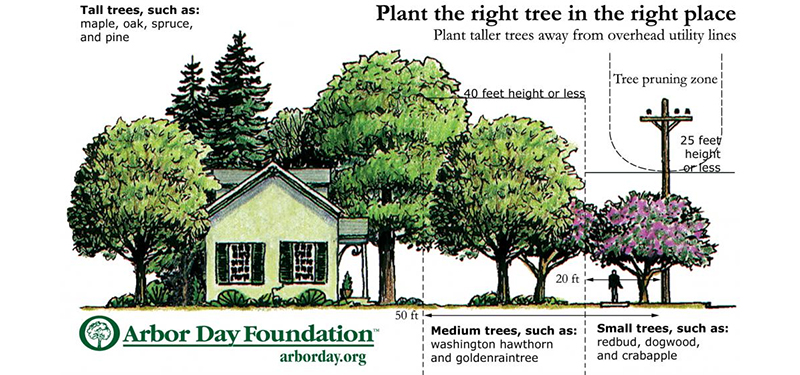 THE RIGHT TREE - Trees must be selected carefully in order to accomplish their intended purpose. Characteristics such as tree shape, size at maturity, flowering, colors and texture should be considered.
THE RIGHT PLACE - Growing space both above and below ground should be considered when selecting a tree. Allowances must be made for the increased size of the tree when it matures. Some of the problems that can be avoided by selecting the proper tree for the available planting space are:
- Damage to houses through cracked foundations, leaves in gutters or abrasion of tree limbs hitting the house.
- Cracked pavement of sidewalks, driveways, porches and patios.
- Sewer lines or septic tanks clogged by roots.
- Dangerous screening by obscuring traffic signs, pedestrians or vehicles.
- Storm damage and electrical problems from trees or limbs affecting utility lines.
If the correct tree species is chosen for a particular site, a tree has less chance of dying and will mature to full growth faster. Planting the right tree species in the right space saves money on maintenance costs over the life of the tree as well as repairs to surrounding features.
Urban Forest Master Plan
The City of Worcester has finalized the development of the first Urban Forest Master Plan. The Plan serves as a roadmap to proactively manage and grow the City's tree canopy and provides a shared vision for the future of the urban forest to help inspire us to care, plant and protect our trees.
Urban Forestry Tree Commission
The Commission aids the Department of Parks, Recreation & Cemetery, Transportation Advisory Group and the Tree Warden in proactive research, tree inventory, tree campaigns and help increase and protect the City's shade tree canopy and help improve the City's urban community forest overall.
Agenda items must be submitted (3) three business days before each Commission Meeting with the subject line "Agenda Item" to WorcesterTrees@worcesterma.gov.
Protection of Public Trees
The Department of Parks, Recreation & Cemetery is responsible for the care and removal of city-owned trees that are generally located within the sidewalk adjacent to a street and on city-owned property. If the tree is clearly on private property or on a private street, then it is the responsibility of the property owner. If you are unsure who owns a tree, you can call 508-929-1300 to ask for Forestry to help with this determination.
Plant a Tree Near or on Your Property
Planting trees around your home is one of the simplest and most impactful ways to improve your property and your community. Trees help cool your house and yard, clean the air and water, reduce flooding, and add beauty to your neighborhood.
Tree Planting - Next to Your Property
You can request the City plant a tree on the street in front of your property by dropping a pin on the 311 app and website or by contacting 311 via phone, email or chat. Requests must be submitted by property owners. If you are a tenant and would like a tree planted in front of your home, please coordinate with your landlord. Your request will be considered based on factors such as timing of your submission and feasibility of the location. We prioritize denser urban areas (environmental justice areas) that lack robust urban canopy. Trees requested before January 1, 2026 will be considered for Spring 2026 tree planting. The City's contractor will water the tree until it is fully established, under the supervision of the Parks Department.
There is a variety of tree species that will be planted, and they will be selected based on the plant nursery availability, species diversity along the street, as well as the right tree-right place considerations, among others. Many are native species, and all can survive well in tough urban environments.
Tree Planting - In Your Front Yard
In the spring of 2010, Worcester began planting the first generation of tree adoptions on private residential properties throughout the city. This was accomplished after the passage of the Ordinance Relative to the Protection of Public Trees. The program allows for the City to plant a shade tree within the first twenty (20) feet of the public way layout on private property. The tree is the responsibility of the property owner and they are required to care for and maintain it, especially during the first three years of tree establishment.
Tree Planting - In Your Backyard
The City cannot plant a tree in your side yard or backyard. However, you can contact Greening the Gateway Cities program, run by the Massachusetts Department of Conservation & Recreation, at 617-626-1458 to determine if you are eligible for a free tree and schedule an appointment with a forester. Go to: Greening the Gateway Cities Program | Mass.gov to learn more.
Memorial Tree Planting
Planting a tree is an appropriate and time honored tradition to honor the memory of your loved ones. This meaningful memorial is one that will benefit coming generations. Remembering them with a living tree is an act of love for them, their families and our earth. It can also be done in celebration of birthdays, anniversaries, new births or any special occasion. By planting trees in celebration, you can honor your loved ones while caring about the environment and replanting our City's forest. To apply, please fill out the Memorial Tree Planting form.
Invasive Insects
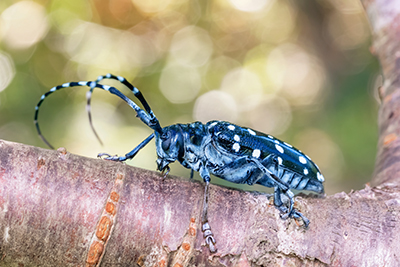
Both the Asian Longhorned Beetle (ALB) and the Spotted Lanternfly (SLF) are invasive insects that are serious threats to a wide variety of trees and vegetation in the United States.
Have a Question?
A City contractor is responsible for planting and maintaining street trees, under supervision by the Parks Department.
There is a variety of tree species on the list (see below) and they will be selected based on the plant nursery availability, species diversity along the street, as well as the right tree-right place considerations, among others. Many are native species, and all can survive well in tough urban environments.
- American Basswood (Tilia americana)
- American Elm (Ulmus Americana hybrids)
- American Hornbeam (Ostya Carolina)
- American Sweetgum (Liquidambar styraciflua)
- Black Gum (Nyssa sylvatica)
- Hackberry (Celtis Occidentalis)
- Honeylocust (Gleditsia) - Skyline
- Fraser Fir (Abies fraseri)
- Ginkgo (Ginkgo biloba) - male only
- Kentucky Coffee Tree (Gymnocladus dioicus)
- Linden (Tilia cordata 'Corinthian') - Corinthian
- London PlaneTree (Plantanus x Acerfolia) - Blood Good
- Pin Oak (Quercus palustris)
- Red Maple (Acer rubrum) - Armstrong
- Red Oak (Quercus rubra)
- Sugar Maple (Acer saccharum)
- Tulip tree (Liriodendron tulipifera)
Public ordinances and the City's Tree Warden determine if a public tree should be removed. Please contact 311 to request an inspection of a public street tree to determine if it's unsafe. Please note: Removing a tree on a private property is the property owner's responsibility.
There's a lot to consider when selecting the right tree for your yard. Take a look at our recommended planting resources through the Tree Species Recommended for Worcester.
Contact Information
Address
Parks & Recreation
50 Officer Manny Familia Way
Worcester, MA 01605
Contact
Phone: 508-799-1190
Fax: 508-799-1293
parks@worcesterma.gov


Hours
Monday - Friday
8 a.m. - 5 p.m.