Salisbury Park is home to Bancroft Tower and holds some of the most beautiful views of Worcester. It is located atop Prospect Hill on the northwestern end of the city.
The Bancroft Tower was built by public benefactor Stephen Salisbury III, who left it to the Worcester Art Museum, which deeded it to the Parks Department in 1912. Salisbury intended the feudal-like castle to be a recreational oasis. Its spiral staircases, fireplace chambers, stone benches and parapets were frequently the scene of picnics and social outings. The summit has a 360-degree view of the city, greatly enhanced by a climb to the lookout tower. A locator map in the stone walkway helps to identify the distant hills.
A Historic Place
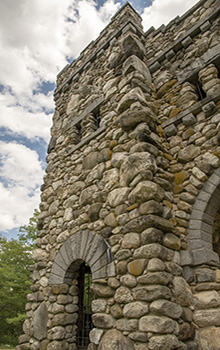 George Bancroft was a politician, statesman and writer. His list of achievements is exceedingly long, ranging from cultivator of the American Beauty Rose and eulogist at Abraham Lincoln's funeral, to Secretary of the Navy (founder of the U.S. Naval Academy at Annapolis) and author of a scholarly ten-volume history of America. But, Stephen Salisbury III built the memorial to Bancroft because Bancroft and Salisbury's father had been childhood friends. A plaque marks Bancroft's birthplace just below the park on Salisbury Street.
Honorable Stephen Salisbury III became a member of the Parks Commission in 1887. Mr. Salisbury owned a great deal of land in the northern part of the city and was always eager to improve that section. He was involved in the donation and development of a plot of land on the south side of Salisbury Pond, soon to be named Institute Park. Initially Stephen Salisbury set aside 20 acres of land along Massachusetts Avenue which included Bancroft Hill.
In 1900, he erected a tower on the summit of this hill to honor George Bancroft, the famous historian whose birthplace was just below on Salisbury Street. The tower is 56 feet high and is constructed of boulders, cobblestones and is trimmed with a rock-faced granite. It looks like a miniature feudal castle. The construction cost was about $15,000. Stephen Salisbury opened it to the public during this time. Some of the finest views in the City could be seen from this tower. It is named on the National Register of Historic Places. When Mr. Salisbury died, this property was left to the Worcester Art Museum who in turn presented it to the City in 1912.
Also Check Out
View some of the other parks in the City. Get out and explore!
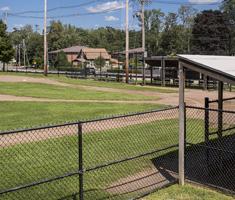
Logan Field
District: 5
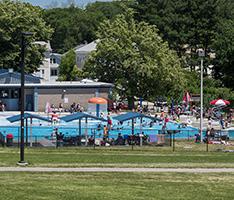
Vernon Hill Park
District: 3

City Hall Common
District: 2
Quick Facts
Location: 26 Massachusetts Avenue - Map
District: 1
Size: 12.0 acres
Parking Lot(s): Yes
Features:
- Monuments/Memorials
Know Before You Go
Contact Information
Address
Parks & Recreation
50 Officer Manny Familia Way
Worcester, MA 01605
Contact
Phone: 508-799-1190
Fax: 508-799-1293
parks@worcesterma.gov


Hours
Monday - Friday
8 a.m. - 5 p.m.